دسته: RRR

  • Twisted or TFO yarn

    Twisted or TFO yarn


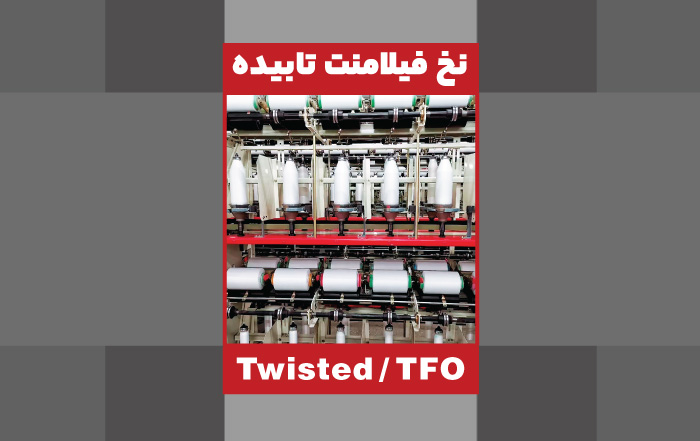
    Twisted or TFO yarn:In this article, we will examine twisted filament Twisted or TFO yarn  The twisting process in polyester filament yarns increases the cohesion of the filaments. Twist refers to twisting the yarn around its axis, and its increase, within the optimal range, increases the strength and improves the yarn underhand.

    Method of production

    ITY, FDY and DTY polyester filament yarns, BCF yarn, melange yarn, nylon yarn and other yarns are subjected to twisting process in single or multiple layers. One of the common methods of producing twisted yarn (Twisted/TFO) is to use a ring spinning machine. The ring spinning machine consists of a rack, yarn spinning section and yarn twisting section on the bobbin, which performs the yarn spinning operation using a ring (or glasses) system. In this method, the yarn is opened from the shelf, then simultaneously twist and wound on the bobbin.

    Another method is to use a two for one twisting machine, which is abbreviated as TFO and the resulting yarn is also called TFO yarn. In this method, unlike the method used in the ring machine, the yarn is first unwound from the bobbin and after applying swing, it is wound on another bobbin. The two for one twisting machine includes the main parts of the bobbin holder, yarn tension, drum and balloon holder. The two-for-one twisting method has production capabilities (including the number of twist per meter) and a higher production speed, so it is used more often.

    Properties

    Twisted yarn or TFO finds special applications due to the appearance and underhand properties using the twisting process. twisted yarn is used in all kinds of silk, crepe, clothing, curtain, etc. fabrics.

    Characteristics of twisted filament polyester yarn (Twisted/TFO) produced in Mr Yarn:

    Fineness range: 50 to 1800 deniers

    tpm: 80 to 3000
  • Lycra yarn or spandex

    Lycra yarn or spandex


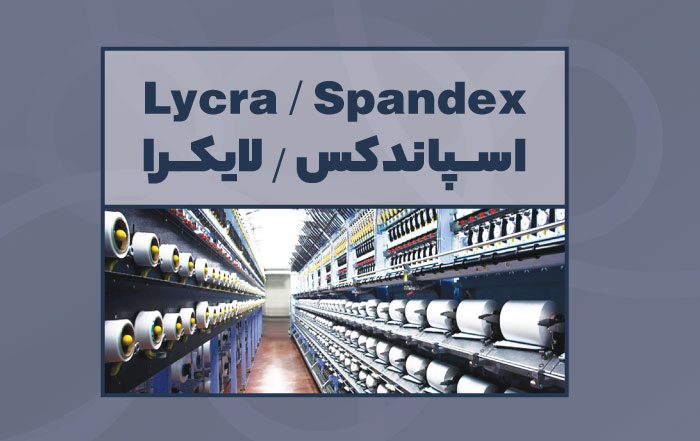
    In this article, we will examine Lycra or Spandex yarn. Lycra is a synthetic fiber that was produced by DuPont in 1958. Lycra is also known as Stomer or Spandex. In its research, the company was looking for ways to produce fibers that have the elastic properties of rubber but at the same time can be used in the textile industry. Plans to commercialize and adopt the Lycra trademark were announced in October 1959.

    The fiber component in Lycra is a long-chain synthetic polymer. This molecular chain consists of at least 85% polyurethane. This means that 100% of the elasticity of Lycra is synthetic and does not contain any natural rubber. Lycra is technically called segmented polyurethane, which consists of soft or flexible parts that are connected with hard parts.

    Features of Lycra:

    It is stretched 4 to 7 times its original length and then returns to its original length.

    It can be repeatedly stretched and released.

    Stronger, more durable and higher tensile strength than rubber

    Light, soft, smooth and flexible

    In clothing, it provides a combination of comfort and shape retention and prevents sagging

    can be dyed

    Resistant to decay by perspiration, lotions and detergents

    Abrasion resistant

    Available in finenesses from 10 to 2500 denier.

    How to use Lycra

    Lycra is usually not used alone and is combined with natural fibers (such as cotton) or synthetic fibers (such as polyester). Lycra in Iran is usually used in grades 20, 30, 40, 70, 110, 140 and 210 denier in combination with different grades of polyester or cotton thread.

    In general, the weaving method used and the type of fabric and its final use determine the amount and type of Lycra needed to ensure optimal performance and beauty. A minimum of 2% Lycra is sufficient to improve the movement of the fabric and maintain its shape, while the fabrics of garments with high elastic performance such as swimwear and sportswear with high body movements may contain 20-30% Lycra.

    Lycra care:

    Hand or machine wash in lukewarm water

    Do not use chlorine bleach on fabrics containing Lycra or Spandex. Use oxygen bleach or sodium perborate.

    Ironing should be done quickly if needed. Do not leave the iron in one position for too long and use a low temperature.

    See the garment care label for specific instructions.

    Some major applications of lycra yarn

    The properties of lycra or spandex yarn open up new areas in fabric construction and design that cannot be achieved with conventional yarns. For example, the:

    Clothing where comfort and fit are desired: tights, swimwear, aerobics and sportswear, ski pants, golf jackets, disposable diapers, belts, underwear

    Protective cover: cable and hose protector

    Sports clothes: cycling clothes and…

  • Melange yarn

    Melange yarn


    Unique color effects can be seen in melange yarn due to the combination of two or more different colors. These color effects change with the wavy pattern in the yarn.

    Types of melange yarns:

    • 100% cotton melange
    • Cotton-polyester melange (with different percentages)
    • Viscose-polyester melange (with different percentages)
    • 100% polyester melange

    This type of yarn is classified into two main types (in terms of gender):

    Mixture: in which, in addition to using different colors, two different genders are combined with each other. Such as cotton polyester melange yarn and viscose polyester melange yarn, which are mixed together in different percentages with different colors.

    Non-mixed: yarn in which different fibers are not combined, but different colored fibers of the same species are used to produce yarn, such as 100% cotton melange yarn. or 100% polyester melange yarn.

    Production methods

    Spun yarn: In this method, melange is produced by using the combination of colored fibers and staple yarn spinning process is used to produce it. This method is used for non-mixed melange yarns (such as 100% cotton, 100% viscose or 100% spun polyester) or mixed melange yarns.

    Combined yarn: In this method, separate filament yarns are produced as dope dyed in the spinning process, then two colored filament yarns are combined with each other with the aim of creating the desired color effect.

    Important characteristics of melange

    Environmentally friendly: because the melange yarn is produced in a colored form, which in some of its color combinations is a raw and undyed component, its production, compared to ordinary yarn, due to the elimination of the dyeing stage of yarn or fabric in water and energy consumption It saves and reduces industrial wastewater and reduces the emission of toxic substances, and for this reason, they can be considered environmentally friendly.

    Unique appearance: Melange yarns are very attractive and unique because of the appearance they create in the fabric.

    Common problems in melange production

    In the production of melange yarns by spinning spun yarns, it is very important to pay attention to the mixing percentage of colored fibers to create a suitable color effect. In addition, during the production process of spun melange yarn, the colored fibers must be well mixed together. If the mixing of colored fibers is not done correctly, it may cause color change in the melange yarn. These problems are less observed in melange yarns that are produced from the combination of filament polyester yarns.

    Applications

    According to the color effects of melange, it has different uses. For example, it is used in all kinds of sports clothes and warm clothes, all kinds of dress fabrics, all kinds of car seat covers and all kinds of worsted fabrics.

  • ITY yarn

    ITY yarn

    Brief history:

    To introduce the ITY yarn, we will first discuss the idea of ​​its formation. For the first time in 1960, in Japan, two types of yarn with different properties were combined with each other with the aim of creating a different yarn, and this yarn was called Shingosen (meaning new synthetic yarn). The continuation of the research included the combination of two or more types of yarn with different characteristics (especially thermal shrinkage). Today, ITY yarns, which stand for Intermingled Textured Yarn or Interlock Twist Yarn or Interlace Textured Yarn, are produced from the combination of POY and FDY yarn with different shrinkage percentages. Also, the term (BSY) Bi-Shrinkage Yarn, which means a yarn that shrinks in itself, is also used for ITY yarn.

    Properties:

    Due to the structural characteristics of POY yarn (see the POY yarn article), its presence in the ITY structure improves the dyeability properties. Also, due to the different shrinkage percentage of POY and FDY, the resulting ITY yarn has curls and waves in its structure without the need for warping and thermal stabilization (texturing process). As a result, the resulting ITY yarn without texturizing has a textured state, hence it is known as self-texturing yarn.

    Method of production:

    Two-step method: In the two-step method, POY and FDY yarns are produced in separate processes and then merged together.

    Due to the increasing use of ITY yarns in the textile industry, the mentioned methods are not cost-effective, so a single-step production method is used for its production.

    One-step method:

    With the development and optimization of spinning melting machines, it is possible to produce ITY yarn in one step. In this method, POY yarn and FDY yarn are produced and integrated in a spinning melting machine. This method increases the production speed of ITY yarn to more than 3200 meters per minute.

    applications:

    Due to the mentioned properties, this type of yarn has many uses, including in the production of crepe fabrics. Also, the merging of two types of yarn with different shrinkage percentages causes intermittent protrusions of one component of the overall structure of the yarn, and hence it is used in peach skin fabrics (Peach Skin and Wool Peach) and creates a soft and delicate underhand on the surface of the fabric.

  • FDY yarn

    FDY yarn

    Fully Drawn Yarn (FDY) is produced directly from the melting of polyester spinning chips. Its production process is similar to the production method of POY With the difference that by applying more tension during production, it reaches a perfect makeup. This yarn is also called FOY which means Fully Oriented Yarn.

    According to the production conditions of POY yarns (see the article on POY yarns), due to its low arrangement and poor physical and mechanical properties, POY yarn is usually not used directly in the weaving and knitting industry. Because FDY has a complete makeup, it is used directly in the weaving and knitting industry.

    FDY is usually produced in a semi-dull, glossy form with various cross-sections such as round and triangular, raw white or in various colors as self-dyed (Dope Dyed).

    FDY yarn is used in weaving and knitting. The shiny type with its triangular cross-section is usually used in the production of curtain fabrics, sheets and spun FDY in embroidery and sewing. In general, FDY yarn is used in home furniture fabrics, clothing fabrics, jeans and towels.

    Features of FDY yarn are:

    High strength: FDY yarns are preferred due to their high strength in producing durable and strong products.

    Smooth surface: The completely smooth and flat yarn structure makes FDY yarns have a smooth surface, which makes the fabrics have a better texture and shine.

    High Gloss: FDY yarns have a naturally glossy surface and therefore provide bright and vivid colors in fabrics.

    High dyeability: FDY yarns are very suitable for dyeing and provide lasting colors in dyed yarns.

    High elasticity: FDY yarns have good elasticity, which provides comfort and flexibility in clothing.

  • DTY yarn

    DTY yarn

    For the production of DTY yarn, the semi-arranged yarn (POY) in the texturizing operation is subjected to tension and heat to achieve more arrangement, and curls and waves are created in it, causing the yarn to become bulky and fluffy. POY yarn does not have the necessary strength and conditions for use in weaving and knitting industries due to its low arrangement. The use of tension in the texturing process increases the degree of arrangement and strength of the yarn.

    The texturizing process involves creating creases, curls, and waves in synthetic filament yarns. This operation is done to simulate the physical properties and subordination of synthetic yarns (polyester, nylon, etc.) to natural yarns (cotton, wool, etc.). Although synthetic yarns are superior to natural yarns in some cases, such as structure regularity, resistance to microorganisms and mold, and maintenance methods, they are often very smooth and hard and need to be modified in properties such as undercoat, thermal properties, etc. have.

    For this reason, the process of texturing is used to make this happen. Texturing by changing the structure of the synthetic filament yarn turns its smooth surface into a more voluminous surface with a better underlay. Therefore, by using the texturizing process, the underhand of the yarn becomes soft and smooth, and its covering properties, heat retention and spring properties (reversibility in increasing the length) are improved. DTY yarn is produced in different colors (self dye) and as zero twist, Z twist and S twist.

    Texturing methods

    The basis of the texturizing operation is to change the shape of the yarn and then stabilize it, and its methods, from the past to the present, are briefly mentioned below:

    • Staufferbox: In this method, the filaments are placed inside a warm chamber with pressure, and after leaving it and with the passage of time, they take the shape of “twist” and “curl and wave”.
    • KDK (knit de-knit): in this method, by using knitting and splitting the fabric, the yarn without curls and waves is turned into a monofilament yarn.
    • Friction disks: In this method, the yarn passes through the friction disks and a twist is created in it, and the deformation created in the yarn is immediately fixed by using heat.
    • PIN: A process in which yarn is spun around a magnetic spindle and then deformed and stabilized using heat.
    • Air pressure: the high pressure air flow makes the filaments of the yarn to be tied together and increases the volume and makes the yarn soft and fluffy and makes its properties similar to the yarn of natural fibers. (Air Textured Yarn or ATY)

    Also, by creating a welding point or a knot (mingle) at certain distances from the DTY, the amount of filaments can be increased. In this sense, the types of DTY yarn include the following:

    • Simple (no welding)

    Intermingle (strong welding)

    Cumingle or perimingle (weak welding)

    DTY yarn is used in weaving and knitting, to produce clothes, bed sheets, curtains, blankets, rugs, carpets and industrial textiles.

    • Fineness range: 50 to 1500 denier
    • Filament number range: 48 to 576
  • POY yarn

    POY yarn

    partially oriented  yarn (POY) is produced by melting polyester granule chips.

    In the melt spinning process, the polyester granule is melted at high temperature and then converted into filament. Finally, the filaments are put together and form the POY yarn.

    POY yarns are produced with different filament cross-sections, including circular, triangular, multi-ply and square or flat. Each of the cross-sections creates a different feature in the yarn, which is important in different applications. For example, the shape of the cross section of the filament is effective on the properties of compressibility, polish and luster of the yarn and the final product.

    The low arrangement of molecular chains in this yarn determines its physical and mechanical properties. Due to the low elongation and strength of POY yarn, it is not directly used in weaving and knitting industries.

    POY yarns are used in the production of other filament yarns including DTY, FDY, ITY, ATY and lycra. Therefore, the melting conditions of POY yarn will be effective in the production process and the quality of other filament yarns and the final fabric.

    Mr Yarn produces semi-dull and super bright yarns in different grades.